Thursday, 25 April 2019

Preparation for the 7 May 2019 Session

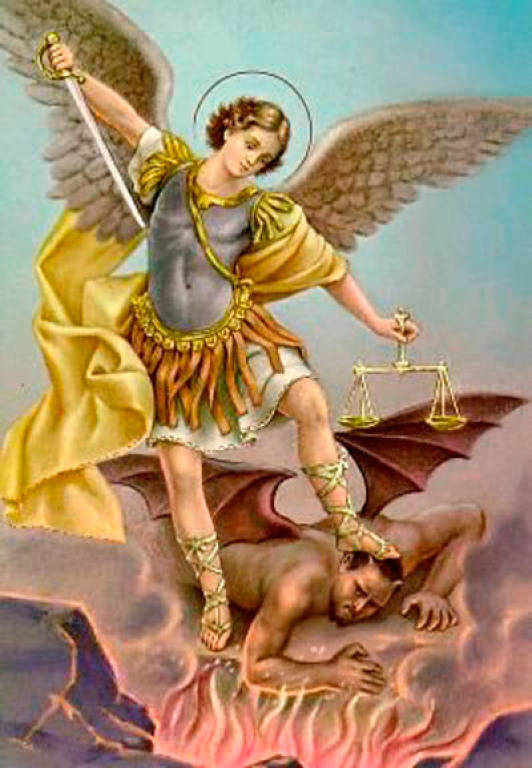
Resultado de imagen para raphael michael gabrielReading: Aquinas, Thomas. De ente et essentia (chapters 4 to 6, paragraphs 88 to 113).

This second part of the reading we started discussing in March (see corresponding post) passes from the concepts already reviewed in the previous chapters (1 to 3) to see how essences are found mainly in three different substances: God, intellectual (purely spiritual) substances and human beings (who are spiritual and material). St Thomas develops these ideas in chapter 4 (paragraphs 88 to 98).

Chapter 5 (paragraphs 99 to 112) is devoted to explain how essence is found in accidents. Accidents can be defined (to a certain extent), and if we can say that they are something we are referring to their essence. But their essence and that of substances is different.

Chapter 6 is the conclusion not only of the previous two chapters but of the whole opuscule too.

As an introduction to help your own analysis here are some hints:

(1) God's (philosophical) definition is the substance whose essence is being (remember that what the translation we are using calls "existence" should be called by the less literary but more accurate "act of being" corresponding to the Latin "esse"). Other substances have received the act of being which is different from what their essence. But God who is the source of being itself is infinitely actual and simple, not divided in any way. [See paragraphs 89-91.]

(2) Separate intelligences are the philosophical term for what with the aid of Revelation we commonly know as "angels" and denote spiritual beings serving God (in Latin angelus, in Greek ἄγγελος, meaning in both cases "messenger"). Among other such messengers or servers, the Bible mentions Michael, Gabriel, Raphael and the guardian angels. St Thomas describes them as substances not limited by matter (like humans) but not cause of their own being either. They have received being each according to a different capacity--their essence. What distinguishes one separate intelligence from another is the "level of act of being" they hold, with some very close to God and some (the lowest ranked) close to humans. Each of these intelligences is a species to itself. [See paragraphs 92-97.]

(3) Finally human beings are the lowest substance, a composite not only of essence and act of being (like the separate intelligences) but also of matter and form. It is possible for all human beings to belong to the same species because each is limited, individuated from the rest by its matter. [See paragraph 98.]

(4) That's for act of being and essence in substances, which are "self standing entities". But how can we speak of accidents (things which "live" in a substance, which are predicated of a substances, such as "tall" referred to a person)? St Thomas will explain how their essence is qualified and their definition incomplete, always depending on a substance to become complete. [See paragraphs 99-112.]

Challenges / questions for your reflection while reading:
  • Try to grasp and distinguish the concepts of:
    • essence and act of being (translated in the reading as "existence");
    • substance and accident;
    • matter and form;
    • genus and species;
    • act and potency.
  • If, unlike the separate intelligences (each of them a different species), all human beings belong to the same species (have a similar form), how can (if at all) they be identified from one another when they die?
  • If God is pure act of being (Ipsum Esse Subsistens), can we say that he is anything else (Good, Provident, Omniscient, etc.)?
  • We know for sure that humans are material. How can we know we are spiritual too and can we say from a philosophical point of view if we are different from animals (and why)?
    Sunday, 10 March 2019

    Preparation for the 2 April 2019 Session

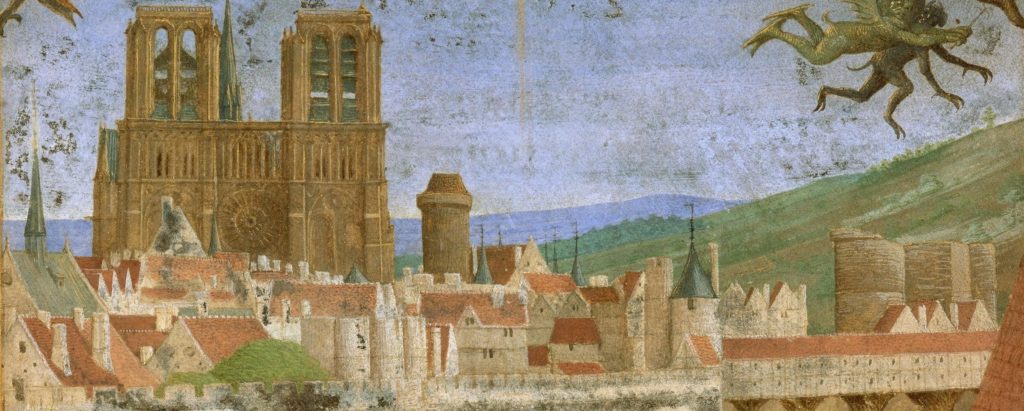
    Resultado de imagen para university of paris in the middle agesHighlights to help your reading of Pieper's Guide to Thomas Aquinas, IV-VI:
    • St Thomas can't be identified as "Aristotelian" (or "Platonist" or "Augustinian" for that matter). He looked for the truth of relevant matters wherever (and from whomever) he could find it. 
    • For St Thomas what Aristotle has to say is important not because Aristotle says it but inasmuch as it is true. St Thomas engaged with Aristotle's ideas, scrutinised them and made them relevant to philosophy in the Middle Ages and beyond. 
    • He deepened on Aristotle because of the Greek philosopher's attention to concreteness, to the natural world, to things as they are in reality. 
    • The discovery of Aristotle and his perspective coincides with a move in Christian thought away from a certain Augustinian contempt for the (natural) world and in favour of a symbolic interpretation of this world as a symbol of the sacred.
    • This discovery could potentially lead to an extreme view away from the sacred (secularisation) and this was the reason Aristotle was seen with reserve by many.
    • For St Thomas, a believer in Sacred Revelation as the highest expression of objective truth, Aristotle represents however an opportunity to revisit an implicit idea present in Christian thought from the beginning: the appreciation of Creation (including the natural world).  
    • Though several universities flourish in the XIII century, some focus more in Law (eg Bologna) or Maths and Sciences (eg Salerno and Oxford), but one, Paris, focuses on the two disciplines that are universal by nature (about the whole of reality): theology and philosophy. Therefore the University of Paris becomes the most important academy of the Western world. 
    • St Thomas arrives there as a student in 1242. He becomes the equivalent of a lecturer (after obtaining his licentia docendi or "permission to teach") in 1256. Due to the "Mendicant controversy" he is barred from membership to an equivalent of the university's teaching union (the universitas magistrorum) and his students are forbidden to attend his lectures. In the meantime he has just concluded De ente et essentia (the small work we are analysing during these weeks) and is composing other works.
    • The matter is so serious that it is not solved till the Pope himself intervenes in 1257, so that Dominican St Thomas and Franciscan St Bonaventure be allowed to teach. During this time Thomas defends the way of life fostered by the Mendicant orders using the disputatio ("disputation").
    • The disputatio was a disciplined form of debate, based on solid argumentation, but still remaining a dialogue with those holding the opposing view. It was a very common way to learn and teach in medieval universities. The second work of St Thomas we'll analyse this year (De veritate) is written in that format.   

    Friday, 22 February 2019

    Preparation for the 5 March 2019 Session

    Resultado de imagen para act and potency"Translation" of some of the terms to ordinary language, just as a first intuitive approach to the concepts (not a full academic explanation) of Aquinas's De ente et essentia, I-III 
    • ​"being" = a verb, the act of being (essse); or = something that "is" in the sense of actively being (ente); 
    • "essence" = that which something is (essentia); all things "are" (have being, esse), each is  a "being" (ente); but how do you distinguish between one and the other? By their "essence" or the what they are (a tree, a human person, etc.);
    • "act" = the principle of "movement" ​​metaphysically understood (from possibility to reality, from capacity to actual perfection);
    • "potency" = the principle of "limitation" or contention of act (possibility before it becomes real, capacity before it reaches perfection). 
    • "substance" = a "proper" being (when "being" means "ente," see above);
    • "accident" = a feature of a substance, something that can or cannot be in the substance without the substance losing what it is.
    • "nature" = the principle of (metaphysical) movement of something, according to what it is.
    • "genus" = a family of species.
    • "species" = what something is, its "quiddity" or essence.
    • "quiddity" = from the Latin interrogative "quid" or what (is)? Used as equivalent to nature, form or essence depending on the context.
    • "form" = the principle of actuality making a being (ente) to have a specific nature. 
    • "matter" = the principle of limitation that makes possible for material beings (entia) belonging to a species to be many. 
    An example. A horse is a being (ente), because is something that has act of being (esse). Before we say anything about it, we take for granted that it is. Its essence (essentia) is to be an animal that eats oats and alfalfa, drinks water, neighs, runs, etc. A foal is a mature horse in potency (potentia), if you train it and care for it to develop to its full ​perfection (actus) or actuality, one day it will run as fast as an adult horse. It is of the substance (substantia) of the horse to have four legs, not one hundred, but whether ​​it's being brown is an accident (accidens): it could be white and still being a horse. It belongs to its nature (natura) to neigh and to run, but not to fly. "Horse" is a species of the genus "animals". The matter of a horse is this matter that makes this horse different from all the other horses. Its form is the nature of a horse that this particular horse shares with all the other horses members of the same species. The essence of a horse comprehends its form and matter. And for a horse to exist essence is not enough it needs the act of being (esse). 

    It can be shown the possibility non material beings or "intelligences"; they can't be differentiate from one another by matter, so each of them is a species constituted of one individual. Still intelligences or non-material or spiritual beings are composed of essence and act of being (esse).


    Some clarifications requested by group members:


    The categories mentioned in the reading refer to what we can say about things, substance and the nine accidents. Substance has act of being in itself and therefore possesses some independence. The accidents are quantity, quality, relation, location, time, position, habit, action and passion and they don't have their own act of being but live in another. You can find a simple explanation here and a comprehensive one here.


    To better understand paragraph number 18, St Thomas is saying that through the form something acquires not only the act of being, but the act of being in a certain, specific way. The form "whiteness" causes something concrete to be white. But the key to understand the paragraph is the conclusion: "It remains, therefore, that the word 'essence' in composed substances signifies that which is composed of matter and form". Not only act of being, but matter and form which make for instance a horse not just any creature or just any horse, but this concrete brown, 4 year old horse that I'm riding.   


    Prime (undesignated) matter is the principle of material potentiality to become anything, but it's pure indetermination. Designated matter (materia quantitate signata) means the matter that has been actualised in a certain way, i.e. a matter that has received a form to become something (eg a horse). 


    Finally, in paragraph 28 St Thomas is not saying that the human being has two natures (as we say of Christ assuming the human and the divine nature), or that he has two different essences in one (eg a frog and an eagle). The key to understand the paragraph is "perfection". So the essence of humans implies both the sensitive perfection (shared with animals) and the intellectual perfection (shared with spiritual beings). But he is speaking about human beings as being one essence only.


    2019 Program

    Resultado de imagen para josef pieper5 February: Josef Pieper, Guide to St Thomas Aquinas ("Guide"), chapters I to III.

    5 March : Thomas Aquinas, Being and Essence ("De ente et essentia"), chapters 1-3.

    2 April : Guide, IV-VI.

    7 May: De ente et essentia, 4-6.

    4 June : Guide, VII-VIII.

    2 July: Thomas Aquinas, On Truth (De veritate), chapters 1 to 4.

    6 August: Guide, IX-X.

    3 September: De veritate, 5-8.

    1 October: Guide, XI-XII.

    5 November: De veritate, 9-12.


      To join our mailing list or for any questions/comments click here.

      Saturday, 22 September 2018

      Preparation for the 2nd October 2018 Session

      Resultado de imagen para veritatis splendor humanae vitae
      Reading:"​​Veritatis Splendor (​regarding certain fundamental questions of the Church's moral teaching)," by St John Paul II. If you plan to read it electronically, you can access a very readable version ​​by clicking here

      Date: Tuesday the 2nd of October 2018.

      In last month's discussion ​on Blessed Paul VI's Humanae Vitae and ​​​Elizabeth Anscombe's Contraception and Chastity, ​​we analysed the Pope's and Anscombe's assessment of what then was a new type of contraceptive (the pill), in the context of the Church's traditional teaching on marriage. 

      The ideas in Humanae Vitae, which itself had followed Pius XI's Casti Conubii, would be further expounded in John Paul II's apostolic exhortation Familiaris Consortio. This is an example of what Blessed Cardinal Newman called an "organic development" of the Church's teaching--in this particular case on married life.

      Twenty-five years on, however, the confusion existing in very specific fields of the moral teaching of the Church had spread to many others, often propounded by ​​theological analyses based in deficient philosophical reasoning. The "Philosopher-Pope" on request of many bishops undertook a fully-fledged and philosophically grounded update of Catholic moral teaching to respond to the challenge of moral relativism. Shortly after the publication of the current Catechism of the Catholic Church John Paul II released Veritatis Splendor in 1993. 

      In addition to "Love and Responsibility," on Catholic sexual morality, which he wrote in 1960, Karol Wojtyla wrote extensively in moral and anthropological philosophy. His most important philosophical work is "Person and Act" published in 1969. He is also author of the encyclical that gives name to our group and whose 20th anniversary we celebrate this Friday 14 September: Fides et Ratio.

      For purposes of your preparation for the next session, the whole of Veritatis Splendor is hugely important, however if you are pressed with time and have to choose, start with Chapter II "The Church and the Discernment of Certain Tendencies in present-day moral theology," and note how much philosophical reasoning is used in the analysis and assessment of those tendencies.


      To join our mailing list or for any questions/comments click here.

      Friday, 1 December 2017

      Faith & Reason 2018 Program

      Resultado de imagen para dietrich von hildebrand edith stein20th of February - Josef Ratzinger

      Introduction to Christianity [1968]


      o   Chapter 1: ‘Belief in the World of Today’ (pp. 39-81).


      27th of March - Etienne Gilson


      The Christian Philosophy of St Thomas Aquinas [1956]


      o   Introduction (pp. 3-25).


      24th of April - Dietrich von Hildebrand


      Man, Woman, and the Meaning of Love [1966]


      o   Chapter 7 ‘Friendship between man and woman’ (pp.98-120).


      22nd of May - Edith Stein


      Essays on Woman, Collected Works [1930]


      o   Chapter 4 ‘Fundamental Principles of Women’s Education’ (pp. 1-11).


      19th of June - Jacques Maritain


      An Introduction to Philosophy [1930, orig. French 1920]


      o   Chapter 4 ‘Plato and Aristotle’ (pp. 37-55).


      24th of July - Josef Pieper


      Guide to Thomas Aquinas [1986]


      o   Chapter X (pp. 117-133).


      28th of August - Elizabeth Anscombe


      o   Anscombe, ‘Contraception and Chastity’[1972]


      o   Paul VI, Humane Vitae [1968], New Translation (2018)


      2nd of October - Saint Pope John Paul II


      o   Veritatis Splendor [1993]


      30th of October - Robert Spaemann


      Love and the Dignity of Human Life: On Nature and Natural Law  [2012]


      o   Chapter 2 ‘Human Dignity andHuman Nature’ (pp. 27-44).


      20th of November - Cornelio Fabro


      Selected Works. Volume 1: Selected Articles on Metaphysics [various]


      o   Chapter 3 ‘The Intensive Hermeneutics of Thomistic Philosophy: The Notion of Participation’ (pp. 449-491).


      To join our mailing list or for any questions/comments click here.

      Thursday, 1 December 2016

      Faith & Reason 2017 Program

      Resultado de imagen para mariano artigas9th ofFebruary - Metaphysics andOntology

      1.     ‘Metaphysics’ (Artigas, pp. 41-50).
      2.     Chapter 12 and Chapter 13 (John Young).

      9th of March - Philosophy of Nature

      1.   ‘Philosophy of Nature’ (Artigas, pp. 51-58).
      2.  Aristotle’s Concept of Nature: Traditional Interpretation and Results of Recent Studies (YouTube video and transcript)
      3.  Aristotle's Natural Philosophy - Stanford Encyclopaedia of Philosophy (Optional).

      20th of April - Philosophy of Human Beings and living beings

      1.     ‘Philosophy of Living Beings’ (Artigas, pp. 59-64).
      2.     Suma of the Summa (Aquinas, ed. Kreeft pp. 243-266).
      3.     Chapter 10 (John Young) (Optional), pp. 173-194.

      11th of May - Moral Philosophy

      1.     ‘Ethics' (Artigas, pp. 65-69).
      2.     Chapter 3 'Are there any moral absolutes? Finding Blackand White in a World of Greys' (Kreeft, Making Choices, pp. 27-38).
      3.     Chapter 5, ‘Twelve Little Boxes Morality Won’t Fit Into' (Kreeft, Making Choices, pp. 53-72).
                                                                                                                  
      8th of June - Philosophy of knowledge and Logic

      1.     ‘Logic’ (Artigas, pp. 71-77).
      2.     Chapter 6 ‘Knowledge in General’ (John Young), pp. 109-122.
        
      13th of July - History Philosophy Part I – Ancient andMedieval Philosophy

      1.     ‘History of Philosophy’ (Artigas, pp. 79-89).
      2.     Chapter 1 (John Young), pp.  9-27.
      3.     Chapter 2 (John Young), pp. 29-43.

      10th of August - History Philosophy Part II – Modern andContemporary Philosophy

      1.     Chapter 3 (John Young), pp. 45-68.
      2.     Chapter 4 (John Young), pp. 73-92.

      27th ofSeptember - Theology andPhilosophy

      1.     ‘Theology as Science’ and ‘Philosophy and Theology’ (Artigas, pp. 93-110).
      2.     ‘Faith, Philosophy and Theology’ (Ratzinger, pp. 13-29).

      25th ofOctober - Christianity andPhilosophy

      1.     ‘Philosophy and Christianity’ (Artigas, pp. 111-119).
      2.     ‘The Crisis of Cultures’ (Ratzinger, Part 1 Crisis of Cultures, pp ).

      22nd ofNovember - The Christian andPhilosophy

      1.     ‘The Christian before philosophy’ (Artigas, pp 121-131).
      2.     Chapter VII 'Current Requirements and Tasks' (pts. 80-99) and 'Conclusion' (pts. 100-122) Fides et Ratio (St Pope John Paul II).


      To join our mailing list or for any questions/comments click here.

      El amor como sentido del hombre en Carlos Cardona

      Prefacio El presente estudio tiene como propósito presentar a un pensador que murió hace apenas doce años, y que por varios motivos pudiera ...